


Full House.
Maximum revenue.

Partners


%20-%20Goingapp.svg)
%20-%20Jegymester.svg)

What is dynamic pricing?
Immediate but stable revenue growth of 8-20%.

Achieving full-house capacity (where possible - or 50% fewer unsold tickets).

Benefiting from stronger demand while maintaining ability to offer discount prices to special customer groups.

95% reduction in time spent on pricing (compared to manual updates).

Shaping customer behavior (e.g. directing demand towards off-peak periods).

Better understanding of customer behavior.

Addressing lower than expected demand with carefully, real-time adjusted prices instead of large last minute discounts.

Reducing unwanted secondary market players.

What we do NOT do


Is it for
you?


Why Dynamo?


Client success in numbers
16%

70%

100%

Get ready to reach new heights with DynamO!

Learn and
improve pricing
consultation

Set up your account
connect in minutes

Customize your pricing

Launch
events

Sit back and enjoy

Happy Clients Speak
-Testimonials


Our Blog
Across the UK performing arts sector, no two organisations sell tickets in quite the same way.
A major festival may need to respond to rapidly changing demand across hundreds of performances in a concentrated sales window. A regional theatre may be balancing year-round programming with the buying habits of a loyal local audience.
These differences make the sector a particularly useful test of what dynamic pricing can achieve. Rather than relying on a single formula or pricing pattern, success depends on adapting to the way demand develops for each organisation, production and performance.
Recent DynamO results illustrate this clearly. Edinburgh International Festival and Watermill Theatre have both generated double-digit average revenue uplift through dynamic pricing.
Case study: Dynamic pricing across the UK culture sector
From Edinburgh International Festival to Watermill Theatre, DynamO is supporting organisations with very different audiences, programmes and sales cycles.
Below, revenue uplift is defined as the additional ticket revenue generated, compared with what the same ticket sales would have generated with static ticket prices. These results sit within the 12-30% revenue uplift range DynamO is currently achieving across arts and culture clients.
Edinburgh International Festival
Across its 2025 Festival, Edinburgh International Festival achieved:
- 16% average monthly revenue uplift
With a concentrated sales cycle, multiple productions and significant variation in demand across events and performance dates, pricing needs to respond quickly as audience behaviour develops.
Leon Gray, Head of Ticketing and Audience Experience at Edinburgh International Festival, says:
“DynamO is a powerful and versatile pricing solution that integrates seamlessly into our tech stack. Most people view dynamic pricing as a commercial tool, but DynamO has helped us to not only increase our revenue but maximise attendance and maintain our commitment to affordability initiatives. It’s been really nice and refreshing to work with a partner that gets who we are and what we are trying to achieve.”
Watermill Theatre
Between January 2025 and July 2026, Watermill Theatre achieved:
- 12% average monthly revenue uplift
Operating in a very different market, the organisation balances artistic programming, local audience development and commercial objectives across a year-round programme.
Different organisations need different pricing responses
These results reinforce something we see consistently across our work in arts and culture: there is no single demand pattern for the sector, and demand can vary dramatically even within the same organisation.
One production may sell strongly as soon as tickets go on sale, while another builds momentum much later. Weekends may behave differently from midweek performances. Particular seating areas, performances or audience segments may develop their own patterns.
That is why DynamO responds at a much more granular level than simply asking whether an organisation is ‘busy’ or ‘quiet’. Each organisation sets where and how its prices can change, and DynamO responds to demand within those parameters.
Responsive pricing should not be confused with surge pricing. Surge pricing raises prices sharply in response to a short-term spike in demand. DynamO works within a price range the organisation sets in advance, making measured adjustments in either direction across the sales cycle.
This can include increasing prices when tickets are selling strongly, but it can also mean taking a more cautious approach or moving prices down when demand is softer. The result is a pricing approach that reflects how audiences are actually behaving.
Supporting both commercial and audience objectives
For cultural organisations, revenue is rarely the only consideration. Pricing decisions often sit alongside commitments to accessibility, audience development, membership, artistic strategy and ensuring that a meaningful range of ticket prices remains available.
Dynamic pricing therefore needs to operate within those priorities rather than independently of them. Teams can determine where pricing is allowed to move, establish appropriate limits and protect specific inventory or price points where required.
This means dynamic pricing can support stronger commercial performance without requiring organisations to abandon the principles that underpin their wider ticketing and audience strategies.
The results from Edinburgh International Festival and Watermill Theatre show what that can look like in practice: double-digit revenue uplift across two very different cultural environments, achieved through pricing strategies adapted to the individual organisation rather than imposed through a standardised model.
See what dynamic pricing could deliver for you
Send us 12 months of sales history and we’ll model your potential revenue uplift, free of charge. Get in touch through our contact form or email info@dynamopricing.com.
Dynamic pricing in arts and culture is more than increasing ticket prices.
For theatres and cultural organisations, the challenge is more nuanced: making the most of periods of strong demand, responding when sales are softer, protecting affordability and ensuring that pricing supports the wider goals of the organisation.
This is where DynamO comes in.
Our very first clients included leading organisations within the Hungarian culture sector, giving us early experience of the particular challenges that theatres and cultural organisations face when balancing commercial performance with audience development and access initiatives.
Since then, DynamO has expanded across Europe and the United States, working with a growing number of theatres, venues, festivals and live event organisers.
Our recent results with a Northeast US theatre and a Pacific Northwest theatre demonstrate how that experience is translating across the Atlantic.
Case study: Dynamic pricing for US theatre
From the Northeast to the Pacific Northwest, DynamO is delivering strong results for cultural organisations operating in very different US markets. These figures, taken from our latest client impact reporting, show the potential for dynamic pricing to generate meaningful incremental revenue across the performing arts sector.
Northeast US theatre
Between April and June 2026, DynamO helped the Northeast US theatre achieve a 19% average revenue uplift.*
Pacific Northwest US theatre
Across a longer period from October 2025 to May 2026, the Pacific Northwest US theatre achieved a 12% average revenue uplift.*
*Revenue uplift is defined as the additional ticket revenue generated, compared with what the same ticket sales would have generated with static ticket prices.
These results sit within the 12–30% revenue uplift range DynamO is currently seeing across arts and culture clients.
While each organisation, market and sales cycle is different, both case studies demonstrate how a responsive, data-led approach to pricing can deliver strong commercial results in a range of cultural settings — with a 5-7x return on cost.
Adapting dynamic pricing to different markets
Working with theatres in different parts of the US has reinforced something we have seen throughout our work in the culture sector: demand behaves differently from one organisation, production and market to the next.
The Northeast US theatre and the Pacific Northwest US theatre operate in very different local markets, with their own audiences, programming and sales patterns. Within each organisation, demand can also shift significantly between productions, performance dates and different stages of the sales cycle.
That is why DynamO does not apply the same pricing rules everywhere. Our technology responds to the demand patterns of each organisation, within the pricing strategy and parameters set by its team.
When demand strengthens, this can mean capturing more value from high-demand inventory. When demand is softer, prices can respond in the opposite direction. This gives organisations a more flexible way to manage pricing throughout the sales cycle rather than relying on static prices or occasional manual changes.
That flexibility is also what separates DynamO from surge pricing. Surge pricing raises prices sharply in response to a short-term spike in demand. DynamO works within a price range the organisation sets in advance, making measured adjustments in either direction across the sales cycle.
Partnerships that support DynamO’s growing presence in the US
Our recent partnership with TRG Arts is helping us reach and support more cultural organisations across the US, combining DynamO’s responsive dynamic pricing technology with TRG Arts’ deep expertise in demand management and arts-sector strategy.
Alongside this, our recent Tessitura and existing Spektrix integrations make it easier for organisations already using these platforms to adopt DynamO within their existing ticketing ecosystem.
Together, these developments are creating more opportunities for US theatres and cultural organisations to access dynamic pricing in a way that fits naturally with how they already work.
We’re excited to continue building our presence in the US, while supporting more organisations across the global culture sector.
What could dynamic pricing deliver for your theatre?
Send us 12 months of sales history and we’ll model your potential revenue uplift, free of charge. Get in touch through our contact form or email info@dynamopricing.com.
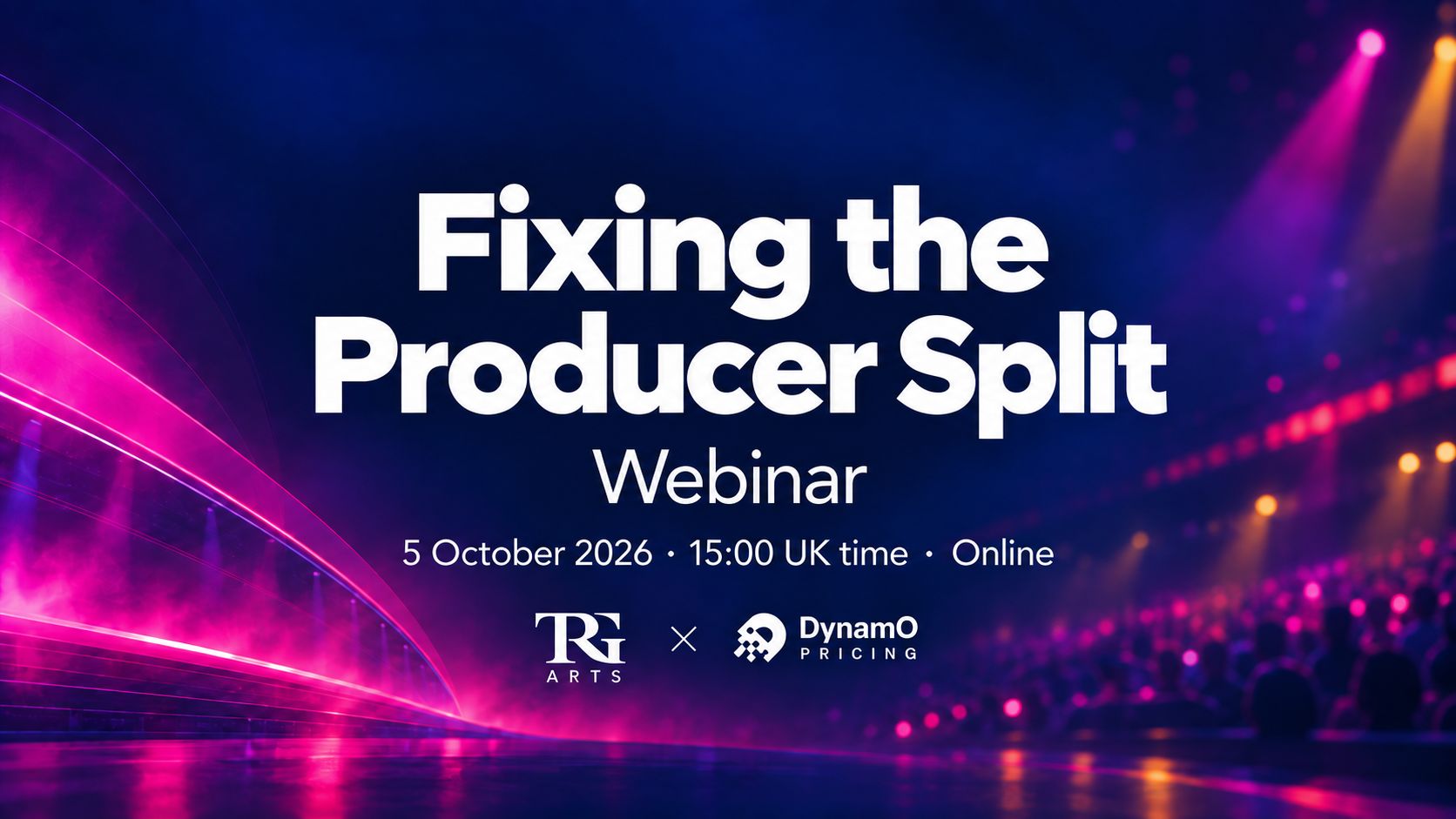
UK theatre venues have carried the financial burden of box office infrastructure, ticketing technology, and marketing - only to steer much of the dynamic upside over to visiting producers.
When most of the extra pound generated by smart pricing flows straight out the door, venues lose the incentive to leverage technology that could improve their entire pricing strategy, not just dynamic pricing. It’s time to break that cycle.
Join DynamO Pricing and TRG Arts for an exclusive commercial working session designed specifically for venue leaders ready to ensure their deals can keep up with the pace of technology.
What we will cover:
- Unlocking the bottleneck: Why traditional split structures freeze venue margins and how to reframe the conversation with producers.
- Contracts that work: Ideas for more modern producer agreements that benefit everyone.
- Reframing positioning: Knowing the worth of a venue and its audience relationships.
Why attend?
This is a direct, commercially focused discussion on how to stop leaving money on the table. You will leave with actionable strategies to take into your next season's programming negotiations.
- Date: Monday 5 October
- Time: 15:00 (UK)
- Location: Zoom
- Registration: Sign up here


